LOT — Part VI Why Tactical Thinking Without LOT Creates False Confidence (and How to Fix It)
Tactical thinking feels powerful. It is decisive. It is visible. It produces fast feedback. And that is exactly why it becomes dangerous when it stands alone.
Tactics create the feeling of readiness long before readiness actually exists. In isolation, they reward performance without testing sustainability, governance, or recovery. Under real pressure, that gap is where failure occurs.
TACTICS REWARD CONFIDENCE, NOT ENDURANCE
Tactical skills produce immediate feedback. You either hit the target, or you don’t. You either execute the drill, or you fail it.
That clarity is addictive.
But real-world crises and situations do not reward isolated excellence. They punish systems that cannot sustain themselves.
Tactics answer: “What can I do right now?”
They do not answer: - How long can I keep doing this? - What happens after success? - What fails next? - Who replaces me when I’m exhausted or injured? - What happens when conditions change faster than I can adapt?
Those questions live outside tactics.
They live in Logistics and Operations.
Example: Skill Without Sustainment
A trained individual can run repeated high-tempo drills for an afternoon. But without water resupply, calorie planning, sleep cycles, or equipment maintenance, that same individual degrades sharply within 24–72 hours. The skill didn’t disappear—the system supporting it did.
FALSE CONFIDENCE IS A SYSTEMIC FAILURE
False confidence is not arrogance. It is incomplete design.
People believe they are ready because: - they trained hard - they rehearsed scenarios - they own capable tools - they performed well in controlled conditions
But confidence built on tactics alone collapses the moment friction appears (i.e. “no plan survives first contact”).
Friction looks like: - fatigue at the wrong time - missing gear or depleted consumables - poor information flow - unclear authority - overlapping or conflicting decisions
Without Logistics and Operations supporting them, tactics consume themselves.
Example: The Single-Point Performer
Many preparedness plans quietly assume the same person will always: - lead - execute - decide - recover
That works—until that person is unavailable. When there is no role rotation, no redundancy, and no handoff protocol, tactical excellence becomes a single point of failure.
WHY TACTICAL THINKING DOMINATES PREP CULTURE
Tactics dominate because they are marketable.
You can sell: - courses - drills - gear - techniques - hero narratives (i.e. “high speed, low drag”)
You cannot easily sell: - inventory governance - consumption tracking - role rotation - decision authority models - failure thresholds
So, the visible parts of readiness get amplified, while the invisible parts are ignored.
Example: Gear Without Accounting
Owning capable equipment feels like readiness. But without knowing burn rates, maintenance intervals, replacement timelines, and storage limits, gear becomes a false proxy for capacity. The question is never “Do you have it?”—it is “How long does it last?”
LOT exists to correct that distortion.
THE FIX IS NOT LESS TACTICS — IT IS CONTEXT
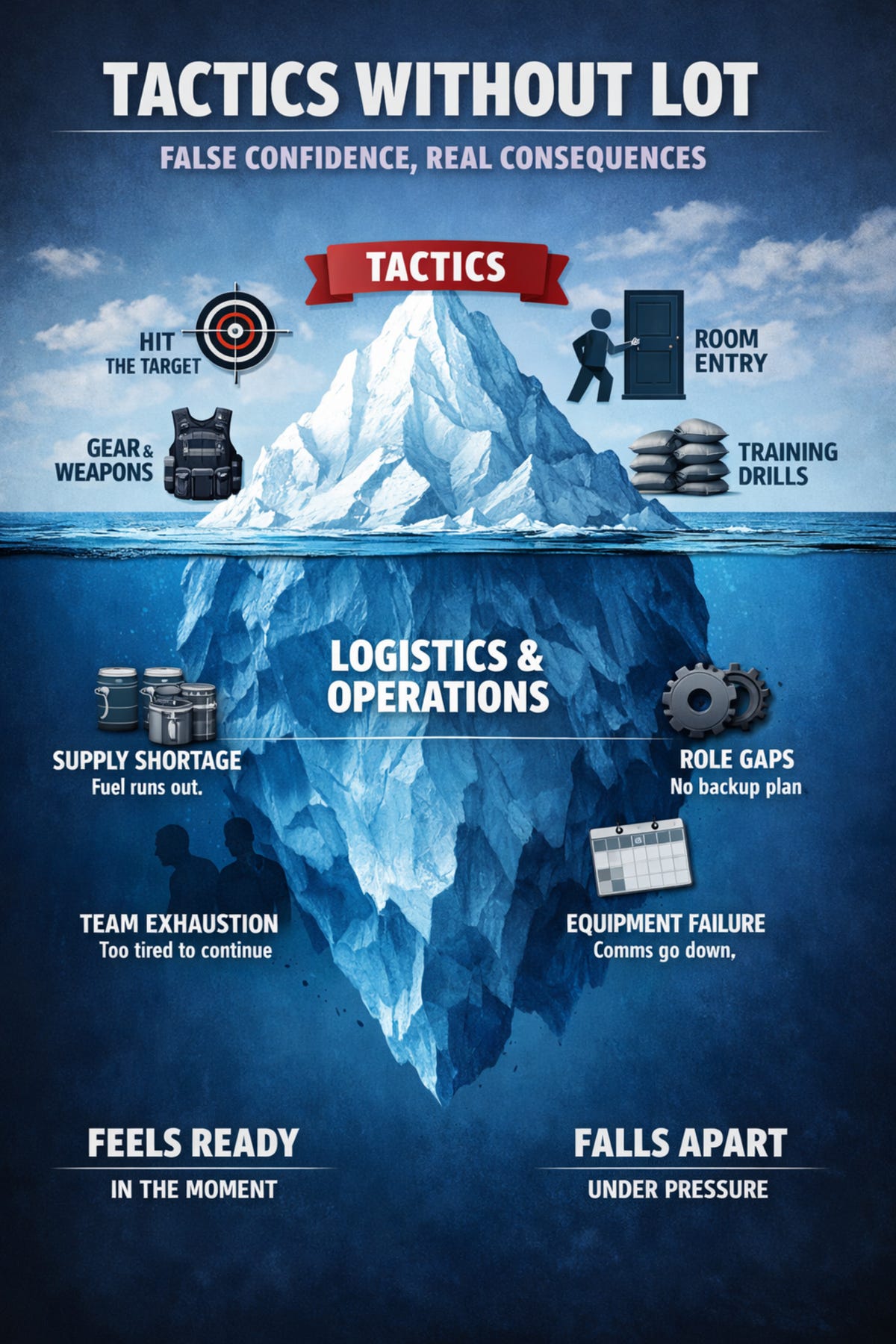
Figure: Tactical actions feel decisive above the surface, but without Logistics and Operations beneath them, confidence collapses under pressure.
This is not an argument against tactics.
It is an argument for placing them correctly.
When tactics are embedded inside LOT: - logistics sustains them - operations sequences them - leadership governs them - recovery is planned - degradation is expected
Tactics stop being fragile. They become durable.
Example: Sequenced Capability
A tactic used once may succeed by skill alone. The same tactic used repeatedly requires: - resupply windows - personnel rotation - decision checkpoints - clear stop conditions
Operations turn isolated actions into a sequence. Logistics keeps that sequence alive.
HOW TO BUILD REAL CONFIDENCE
Real confidence does not come from bravado or repetition.
It comes from knowing: - where your limits are - what breaks first - how long you can operate - who takes over - when you stop - how you recover
That confidence feels quieter. Less dramatic. Less performative.
But it survives contact with reality.
Example: Planned Degradation
A mature system plans for decline. It assumes reduced capability over time and builds decision triggers around that reality. When performance drops below threshold, the system adapts instead of collapsing.
THE LOT STANDARD
If your plan depends on: - perfect execution - uninterrupted energy - flawless coordination - constant motivation
It is not a plan. It is a hope.
LOT replaces hope with structure.
· Logistics provides capacity and endurance
· Operations provides continuity and sequencing
· Tactical provides immediate effect
Only together do they create readiness.
SERIES CLOSE
Preparedness is possession. Readiness is performance.
LOT is how you bridge the gap—before pressure forces the lesson.
The best S/G3 officers i worked with always had the S/G4 officer and senior noncom in the loop and all IPRs and strategy meetings. At the top of the list was What are the stockages of equipment and supplies? How quickly. An it be resupplied when it starts running low? How will it be moved to the front line troops? Do we have enough vehicles? What is the back up plan if the roads get cut off? These were the ones i loved working with. They always started with logistics and then built off that. Based off of what the S/G4 informed them they were able to build the strategy and tactics needed to accomplish the mission
S/G4= S4 is Brigade and below G4 is general staff both deal with all forms of logistics to include ordering, stockage, maintaining, shipment, maintenance of vehicles, food and cooks, and such
IPR.=Intitial Planning Review
Very important process to remember. Without support , supply and logistics your mission will fail . Thanks